

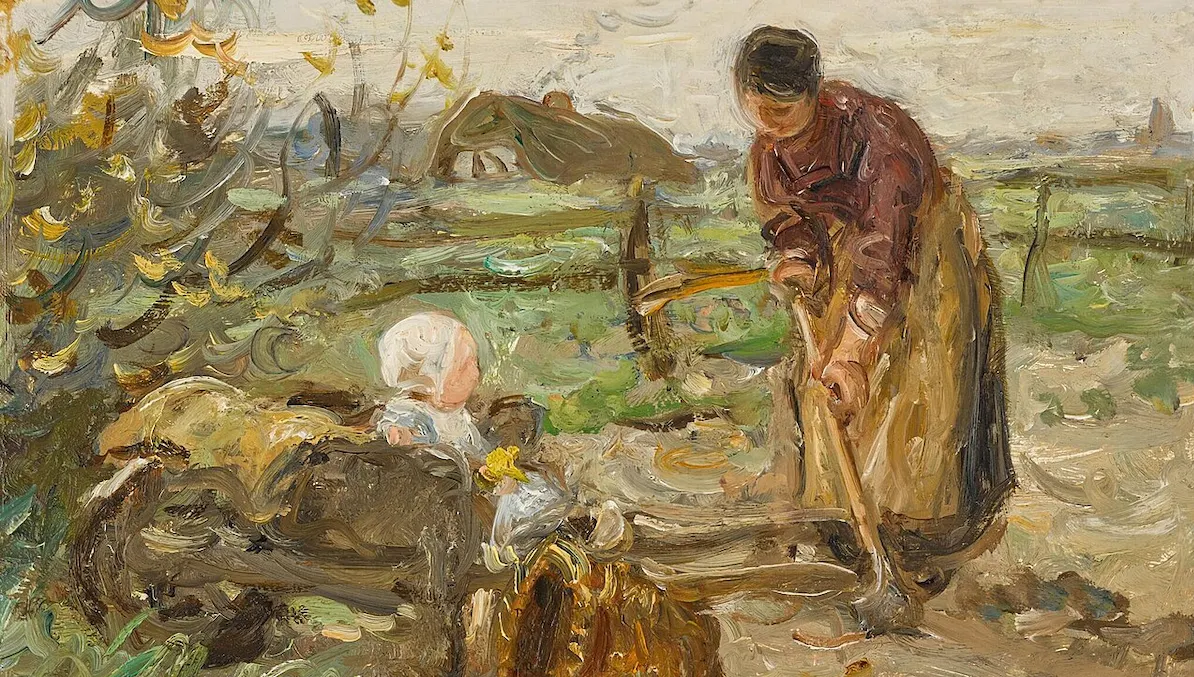
Below is an edited version of the remarks that Ivana Greco originally delivered in Rochester on September 18th as part of a breakout session on “Care Work” at the 2026 Women’s Convention. Nadya Williams’ remarks are available here and Stephanie H. Murray’s remarks are available here. A full, unedited video of the breakout session can be viewed here.
At the September 2026 Women’s Convention in Rochester, NY, panelists and audience members had the chance to discuss caregiving and ways in which we could better support the men and women who do the work of the home. Together, I think it’s fair to say, panelists and audience members reached two conclusions. First: care—the experience of tending, nurturing, and stewarding another person—is a very human issue. Second: this important work, whether you call it “caregiving,” “homemaking,” or some other term, should rightly be the subject of interest and support by our small common societies (e.g., neighborhoods, church communities), businesses, and policymakers.
During the panel, I asked audience members to raise their hands if they took care of their own children. The majority of the room indicated they did. I then asked whether they took care of someone other than a child—an elderly parent, a disabled sibling, or someone else in their family or community. Again, many positive responses. Finally, I asked everyone who was caring for more than one category of person (for example, both a child and an aging parent) to raise their hands. I would estimate that about a quarter of the mostly female audience said they were responsible for caring for both a child and a parent, a child and a community member, etc.
Care, as the women and a few men in the room reflected, is an issue that touches almost everyone. When I go to conferences, speak on panels, and conduct roundtables, I find it is a unique issue that can cut through a lot of noise and truly touch the hearts of almost everyone who considers it, whether they be rich, poor, Republican, Democrat, atheist, religious, etc.
In politics, analysts sometimes talk about “wedge issues,” or issues that split a group. I think of care as the opposite: it’s a “bridge issue,” or even a “magnet issue,” capable of drawing together diverse people because they face a common challenge.
Care as a Bridge Issue
Here are a few stories to illustrate the idea of care as a bridge issue, or one capable of healing our fractured electorate if approached correctly. I tell these stories to illustrate (1) how issues surrounding caregiving cut across our political, economic, and cultural divisions and (2) what a core issue this is for many people.
The first story: several years ago, I conducted a phone interview with a mom with young kids. As I remember it, she was cooking dinner and talking to me with her kids underfoot… while I was also cooking dinner with my kids underfoot and trying to take notes. This may not have been the smoothest interview process, but I do think that it led to some genuine connection.
This mother said that she and her husband had originally worked at the same manufacturing plant. After their first child was born, they put the baby in daycare, but it was quite expensive, and they felt pressured by the busy schedule of work and driving to daycare. Once their second child was born, they moved to separate shifts to save money on childcare costs. As I recall, Mom worked the day shift and Dad worked the night shift. This was unsustainable. Eventually, Mom quit her job to be home with her children, and the whole family moved into her parents’ basement, which allowed them to stay afloat financially.
I know from research I have collaborated on at Capita, a nonpartisan think tank, that shift work, especially unpredictable or overnight shift work, can put major pressure on families with young children. At the Rochester convention, this was driven home by a woman from Middle America who told me a heartbreaking story about the impact of nighttime shift work on a family member, echoing other stories I have heard about parents working overnight shifts who must choose between sleep and caring for young children.
The second story: I interviewed a mother who cares for a son with global developmental delays. This mother shared her concerns that as her son grew bigger, she would no longer be able to care for him, including no longer being able to bathe him safely as he became too strong for her to control, especially while wet. The concerns I heard in this interview are similar to others I have heard many times since then from other parents of children with complex behavioral or medical needs. Indeed, at the Rochester convention, issues surrounding children who are not developing typically and need special care and support came up repeatedly in side conversations. This is truly an issue that impacts parents at all levels of the socioeconomic scale, in all corners of the country, across the political spectrum.
The third story: this one is my own. We often think of care, especially for the elderly or the disabled, as burdensome—a problem to be avoided if possible. However, my own father was diagnosed with esophageal cancer shortly after my husband and I were married. He eventually succumbed to the disease eight months after my first child was born. I remember holding my father’s hand while he was dying, even as I used my other hand to nurse my infant son. It was a true “circle of life” experience, and one I found profoundly beautiful and mysterious. Indeed, as a Catholic, I believe it was a moment to have been filled with special mercies from the Holy Spirit.
Supporting Caregivers
As these stories illustrate, caregiving has the potential to be an issue that bridges divides between diverse groups of people. How do we approach this question with the intention of creating a politics of solidarity? Here, I want to draw a little on the writing of Pope Leo XIV. In Magnifica Humanitas, he—like Pope St. John Paul II before him—called for the creation of a “civilization of love,” which he describes as “a social order in which justice and charity are intertwined and love becomes the guiding principle of economic, political and cultural life.”
Obviously, many Americans are not Catholic, and I am certainly not arguing that policymaking in the U.S. can or should adopt Catholic theology. Even so, I believe that this vision of entwined bonds of love creating a better society for us all is particularly relevant when discussing caregiving and the work of the home. How can we think about treating caregiving and caregivers in this spirit?
The most important goal is to change the culture. When discussing the major issues facing ordinary Americans, many reach first for policy levers. What program or funding can we allocate to reach our desired result? What laws or regulations do we need? While I do see a role for policymaking in this area, I believe those who care about caregivers should have a different order of importance, ranking needed change as coming from (1) culture, (2) economics, and (3) policy.
First, with regard to caregivers and those who do the work of the home: their first and best protection is usually the communities that surround them—their extended families, neighbors, fellow church members, etc. I asked the audience in Rochester—who, as discussed above, spend significant time caregiving—where they turned first when they needed help. The answers varied tremendously. I heard about meal trains for the postpartum period, a neighbor babysitting a child because Mom needed emergency childcare, a friend who could give a child a ride to an extracurricular event… and the list went on. The common thread? It is usually surrounding community members who have the flexibility and in-depth familiarity with the caregiver’s needs to truly “help the helpers.”
Unfortunately, in recent decades the networks of caregivers who surround and support each other have begun to break down in the United States. As women joined the workforce in large numbers in the 1960s and ’70s, their important and needed contributions in the paid workforce also came at the cost of significant unpaid labor that they had been doing at home and in their wider communities. Some of this labor was picked up by professional charitable organizations. However, many little acts of charity were no longer feasible once many women began to work full time—including helping a new mom avoid the “baby blues” by bringing her a meal, checking in on a frail elderly neighbor, or holding community potlucks to knit neighbors together. As it turns out, these kinds of flexible, responsive caregiving networks were vital, and America is feeling their absence in the form of increased rates of social alienation, skyrocketing depression among isolated new moms, elderly who are aging alone, and other losses.
Second, we must convince businesses to change how they understand caregiving and the work of the home. In 1999, Professor Joan Williams in her important book, Unbending Gender, describes how businesses assume an “ideal worker.” Per Williams, “workplaces still are designed around an ideal worker who starts to work in early adulthood and works, full time and full force, for forty years without a break, taking no time off for childbearing, childrearing, or anything else.”
With the widespread adoption of remote technology after the COVID-19 pandemic, there is now significant scope for businesses to flex around the needs of caregivers, and to provide (at least part-time) jobs at home for those whose main occupation is caring for others. Such flexibility is not only good for caregivers. It is also good for businesses themselves, which are struggling to find good employees in a period of essentially full employment. Still, many of these benefits accrue largely to white-collar mothers with the professional skills to demand flexibility via remote work. Lower-income caregivers—who are more likely to work in jobs that can only be done in person, such as in the fast-food industry, in manufacturing plants, or as healthcare aides—have not yet found as much accommodation from businesses. We are still struggling to make an attractive pitch to businesses regarding why everyone (both employer and employee) is better off when workers can find the flexibility to meld their caregiving and vocational goals.
Finally: policy levers. In theory, as discussed above, caregiving should be an issue that is an especially good target for bipartisan support, as it deeply impacts so many people. In reality, in our polarized political environment, the search for compromise continues. Ideally, policy aid in favor of the work of the home would be as flexible as possible. It should allow parents and caregivers to make the choices that work for them, whether that means care is provided solely by family members, with the assistance of paid caregivers in the home, or within institutions such as daycares or assisted living facilities. One example of such a flexible policy to support caregivers would be increasing the Child Tax Credit. In fact, the Republican-controlled Congress in 2025 passed a permanent increase in the Child Tax Credit. Support that makes it easier for caregivers to step in and out of the workforce would also be deeply useful, including Social Security caregiver credits or even a kind of G.I. Bill for Homemakers.
The women present at the Rochester convention did not reach consensus on any of the suggested policy solutions, although we saw significant scope for cultural and economic shifts that could better support the work of the home. On one issue we did agree: caregivers need care to carry out their important work.