

Below is an edited version of the remarks that Nadya Williams originally delivered in Rochester on September 18th as part of a breakout session on “Care Work” at the 2026 Women’s Convention. We will be publishing remarks from Stephanie Murray and Ivana Greco later this week. A full, unedited video of the breakout session can be viewed here.
Historians pose a danger to themselves and others. The danger to the historian herself is that she might be asked, as I was, to present the history of a very complex idea in fifteen minutes flat. At the same time, there is a danger to those who happen to be spending those fifteen minutes with the historian, for they inadvertently find themselves committed to a ride that is no less rapid than it is bumpy. For this, I apologize in advance.
It is truly an honor to be here with you all, and it was an honor to be asked to talk about the history of care work, a concept that is foundational to my life as both a mother and a writer. It is a particular delight to be on this panel with my dear friend Ivana Greco, and also to finally meet in person Stephanie Murray and Melody Grubaugh, whom I have long appreciated from a distance. Erika Bachiochi, who gave me this assignment, continues to be an inspiration as both a scholar and thinker and as a mother. She lives out the ideals for which she advocates so passionately and eloquently.
Now, I will ask you to put on your seat belts, as we tell the story of an idea over three millennia in fifteen minutes.
What Is “Care Work”?
There is this thing we all do every day without thinking too much, in the moment, of what to call it. It might look like picking up a baby from the crib in the morning, changing her, feeding her, and tending to her many other needs throughout the day. It could look like chauffeuring an elderly friend to medical appointments. It could look like taking care of family members who are down with the flu, when you’re somehow the last one still standing—although maybe not for long. It could look like packing lunch for spouse and kids, folding laundry, helping a child tie his shoes, helping another child find her shoes that are lost under the couch again, and then taking dinner across town to an acquaintance who just had a baby. Or it could look like putting on a nurse’s uniform in the morning and reporting to one’s job at the hospital or a rehab center.
It could look like any of these things—or like many more things I did not name. But we have an umbrella term that covers all of these and many more: care work.
It’s a useful term, I think. It recognizes a key aspect of life in a human body: namely, that all of us need care of various intensities at different points in our lives. It recognizes that someone has to offer this care—whether parents, relatives, friends, or a paid caregiver. The term also emphasizes that “care work” really is work in the fundamental sense; it is the opposite of leisure or rest. It falls under the category of what the Romans called “negotium” or even “labor.” This latter is an appropriate term, as we also use it in modern English for one particular aspect of care work that is specific to mothers: the labor that is required for bringing new life into the world. All of pregnancy, we could say, is care work. And it ends with labor—which, when successfully concluded, ideally results in many more years of care work.
It is important to name concepts. But as a historian, I also think a lot about things we name today that historically did not have a name. For instance, the ancient world did not have a word for care work, just as it did not have a word for civilians or for child abuse or for many other concepts for which we insist on very precise terms today. The lack of such names is not because the things left unnamed did not exist. In the case of care work, someone always had to care for others, after all. Newborns cannot care for themselves, and neither can the sick, the elderly, and others rendered vulnerable for a time or forever. If we look carefully, we can see the work of caring for them in the background of stories familiar to us, such as Homer’s Iliad and Odyssey.
Today, we have our own ways of speaking about such matters, usually in the context of news stories or policy conversations. But I contend that talking about and rightly understanding care work depends less on precision of terms and more on an expanded imagination.
Our modern society’s imagination of care work is stunted, as we embrace efficiency in all things, charity and kindness in none. Stephanie Murray has written, for instance, about the rise of robots in elder care—robots that perform the care work humans shun. I myself have written about the app-propelled bassinets, whose popularity challenges the saying “the hand that rocks the cradle…” What if there is no human hand to rock the cradle? And Ivana Greco has written powerfully about her story of leaving a demanding law career to embrace care work—caring for her small children and educating them at home.
My fellow panelists Stephanie Murray and Ivana Greco will talk about modern policies on care work and their implications. But I’m the historian on this panel, and my task is to offer helpful historical background and context. I would like to offer this historical background in the form of four images that, I think, will help expand our historical imagination for care work, what it has stood for in the past, and what it can stand for today. One point I will make is that ancient literature often gave a transcendent value to care work. But it was Christianity that showed the beauty of care work as the greatest calling—a calling so precious, God himself would take it on for the sake of all of us.
Scene 1: Andromache and Hector at Home
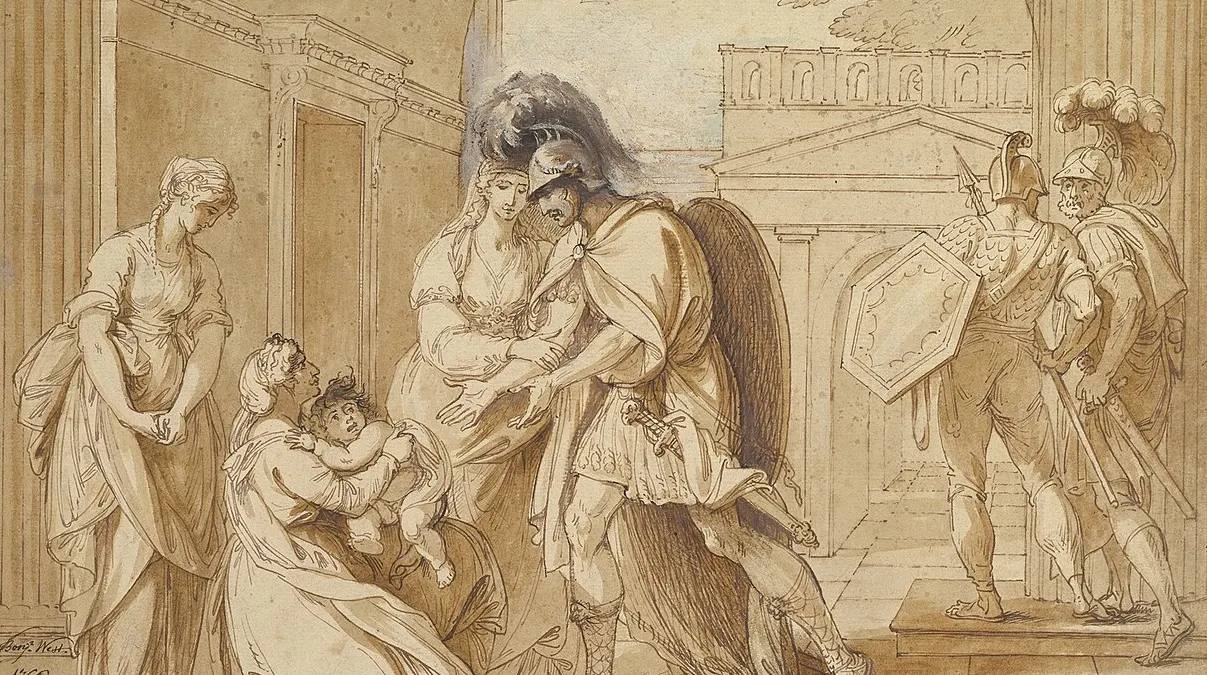
Some of the earliest images of care work in the Western imagination occur in the Homeric epics. In the sixth book of the Iliad, we meet Andromache, the wife of the Trojan hero Hector. The Trojan War is, at this point, in its tenth year. But even here, in wartime, people still get married and give birth—as Andromache did. And so, battle-dust-covered Hector comes home, and his wife lovingly welcomes him with their baby, Astyanax. But when the baby sees Hector’s helmet, with its ominously swaying horsehair crest, he is terrified and starts crying. Hector removes his helmet, picks up his baby, kisses him, and comforts him.
What is the point of this tender family scene? Why does Homer include it in the midst of a war epic? It is a reminder of facts of life that even war cannot interrupt. War is raging, but a baby doesn’t care. Babies don’t know that it is wartime—they still have the exact same needs as they would at any time. The baby, Astyanax, only knows that he wants his dad to hold him and love him—the natural desires of a child for his father. And in the process, Homer shows the true cost of war—the destruction of family, of love, and of marriage.
Even as Andromache is performing her duties as a wife and a mother, she correctly prophesies her future: Hector will be slain. The Trojans will lose the war. Her baby will be killed, and she will be sold into slavery. This is what war does. But until these things happen, every single day, care work must go on. And so Andromache does.
At some point or another, every mother feels a taste of what Andromache experienced to such a dramatic and tragic degree. The world around her may not value her efforts, but she knows that this work of love—of picking up the crying baby, soothing him, and tending to his needs—is still precious and valuable, even when all else is in flames.
Scene 2: Eurycleia Washes Odysseus’ Feet
When we think of care work in the Odyssey, Penelope, Odysseus’ faithful and long-suffering wife, readily comes to mind. She remained faithful to Odysseus during his twenty-year absence, raising their son and caring for the home. But I want to direct your attention to another figure, whose life of care work is perhaps even more interesting. Toward the end of the Odyssey, when Odysseus is at last back at Ithaca but has not yet been recognized by anyone, the hero’s elderly nurse, Eurycleia, washes the unknown guest’s feet. Strikingly, she recognizes him right away by the scar on his leg.
This is the first time in a long while that someone has performed an act of loving care for Odysseus himself. The epic revolves around the many times he comes close to death. His companions, in fact, all die. He returns home alone, bone-weary and scarred in body and soul. And here he is, welcomed home with an act of care: the washing of his feet by the elderly woman who had once been his nurse. In other words, the person who is performing an intimate care task for him now has performed many other intimate care tasks for him since infancy.
Before we go further, it is important to note that Eurycleia is a slave of the family. Her presence is a reminder that much of care work has historically been seen as something to outsource if one had the resources to afford it. Noble families bought or hired wet nurses, just as they bought or hired other servants to educate their children, to scrub their floors, to cook, and to wash the feet of guests. This meant a division of society in the premodern world into two categories of people: the smaller group of those who mostly received the care of others without the obligation of providing care for anyone socially below them. And the larger group of those who had to provide care for the first group, in addition to those in their own group.
Odysseus strikingly shows no gratitude for Eurycleia’s loyalty and recognition of his identity (a detail that is not present in the recent Odyssey film, which depicts the reunion rather differently). On the contrary, he responds quite menacingly, threatening to kill her if she reveals his identity to others. The modern reader is left with a sense of discomfort. We sense that the care worker is a figure to admire, as Homer clearly suggests. Yet the care worker is also a figure at the lowest stratum of society, and someone whose care even her master does not value overly much.
We will return to foot washing in another context shortly.
Scene 3: The Virgin and the Child
Arguably the most popular image of Medieval European Christian art, especially in icons, is that of Mary holding the infant Jesus. We owe the popularity of these images to the Council of Ephesus in AD 431, which sanctioned the cult of Mary as the Theotokos, the Mother of God.
After that date, this particular image of care work was everywhere in the European Middle Ages—in private homes, rich and poor; in churches and monasteries; and in other public settings. It prominently portrayed the care work of motherhood as holy yet matter-of-fact. In various images, Mary is holding the infant Christ as he squirms, or hungrily nurses, or cuddles, or looks at her intently, or seems to be on the verge of falling asleep.
Each image represents a conscious effort of an artist. More important, the variations of the image, because ubiquitous in religious and private art, show a revolution in the imagination that took place as antiquity gave way to the Medieval world. Ancient Greek and Roman pagan art glorified heroes, as statues and busts of warriors, emperors, and gods and goddesses were everywhere. But from the fifth century AD to the present, Christianity replaced these with images of a mother caring tenderly and bodily for her baby. Care work, these images remind us, is holy and ordinary. It is both.
Care work, put simply, is wholly ingrained into the Christian imagination in a way that it was not integrated into any previous religion or philosophical value system. And it is specifically in Christianity that care work became normalized as something that was the responsibility not only of women but also of men.
Scene 4: Jesus, the Good Shepherd
Popular in early Christian catacombs where early churches met to worship in secret was the image of Christ as the Good Shepherd. Jesus, in these paintings, is portrayed as a weary shepherd who holds a lamb or a goat on his shoulders. Bending slightly sometimes under this load of care, he walks along. His posture conveys, each time, a mix of fatigue and affection, as he uses his physical strength to carry the lamb. Believers who repeatedly commissioned this scene in early churches knew that Christ was not just a remote figure. He was their own Good Shepherd, the one who carried them, supporting them with his own strength when the going got tough. His care work, furthermore, was spiritual even more than physical.
The early Christians’ fascination with Christ the Good Shepherd brings to mind other stories of Christ’s care work. The Last Supper, for instance, began with Christ washing his disciples’ feet. On the night he was betrayed, in other words, Christ took on the work of a slave and redeemed it.
Care work was gendered feminine in antiquity. Greek heroes, put simply, did not perform care work. Neither did Greek or Roman aristocrats. Care work was the province of women, especially ones like Eurycleia, a slave. Yet in the Christian story, God incarnate took on care work during his earthly life, showing by his example that this is what ministry to others is. Christ’s engaging in the work of care showed that all persons are worthy of care, just as Christ’s atoning death on the cross showed the preciousness of ordinary human beings, for whom God himself was willing to die. We cannot overestimate just how revolutionary this idea was in antiquity and still is today.
Some Conclusions
Care work today is both a burden and a privilege. Debates over gendered expectations of care work in the home continue to be a minefield that every married couple must navigate. To take care of anyone is hard work. You could pay someone else to do it while you pursue a much more lucrative career. Or you could do it yourself, and that has a high cost of another sort—possibly taking you out of the workforce to focus on care. But what if it is worth it, as some of us believe? What if relationships that develop through care really are priceless? What if this is what it means to be fully, deeply human, especially today, in an age when care robots are real? Our imagination of care work, as I noted at the beginning, needs a lot of help to come to terms with this reality.
Ultimately, problems of valuing care work or denying its significance represent a failure of the imagination. This kind of failure is invariably historical, for it stems from the flawed assumption that the way things are is the way things always have been. But we are here, in this room today, precisely because we think there is a better way.