

The premise is tantalizing: the queen of the tradwives wakes up in 1855 and is forced to live out the old-fashioned life she play-acts on the internet.
Influencer Natalie Heller Mills, of @YesteryearRanch, finds herself in a strange, upside-down world. On a ranch that looks like her ranch, but without heat, electricity, or running water, the shell-shocked Natalie tries to make sense of what has happened to her. Her mind reels as she learns to wash her family’s drab gray clothes in tubs of icy-cold water, the lye burning her chapped hands. When she tries to flee into the woods, hoping to find her way back to modernity, she is promptly caught and beaten by her husband, a man who looks like her real husband and even shares the same name: Caleb. But this Caleb is older and tougher than the one she knows, demanding a level of submission that her weak, malleable, twenty-first century husband would never have dreamed.
This is the set-up for Yesteryear, the debut novel by pop-culture podcaster Caro Claire Burke. The book is “catnip for liberal women,” as my sister-in-law put it. It generated so much pre-release buzz that Anne Hathaway signed on to star in the movie adaptation before the book was even published. Now, it’s at the top of the New York Times bestseller list. It’s already being declared “the book of the summer,” perhaps even “the next Great American novel.” That’s an overstatement. Still, the novel is surprisingly deep, both psychologically and philosophically. Though the pacing lags a bit after the opening scenes, the plot quickly picks back up again in the second half, propelling the reader toward the story’s end, complete with an insane, unexpected, yet somehow believable twist.
Throughout the book, Burke satirizes the world of social media influencers (particularly Hannah Neeleman of Ballerina Farm), right-wing politicians, and “good Christian women” in a way that may strike conservative readers as reductionist, even offensive. Yet she frankly acknowledges the emptiness of the scripts offered to women by liberal feminism as well. As Burke explains in an interview with Lizzy Goodman of the New York Times, “We were all sold a bill of false goods, and that’s true for conservative women and it’s true for liberal women. … The point of the book is not that one wins.” Rather, editorializes Goodman, the fact that “these are often presented as the only two options for women — slutty career girl or repressed housewife — emerges as the tragedy at the heart of ‘Yesteryear.’”
That’s one of the tragedies, to be sure. Yet, in addition to the impoverished scripts offered to modern women, the novel also circles around an even deeper tragedy. In the character of Natalie, Burke offers the most compelling portrait I’ve ever encountered of the phenomenon that scholar and Fairer Disputations Featured Author Angela Franks calls “the empty self.” Natalie’s inner monologue shows the reader what happens when performativity substitutes for a stable sense of self and mutual use replaces relationships built on authentic encounter.
A Deft Satire—But Not of Christian Womanhood
As Natalie tries to figure out what has happened to her, the book bounces back and forth in time. Natalie recalls her decision to flee her conservative community and go to Harvard, her deep distaste for the world of drunken hookups she finds there, and her decision to drop out and get married during the summer after her freshman year. Through one episodic fragment after another, the reader follows Natalie from memory to memory.
We watch Natalie discover, after the birth of her first child, that she’s made a horrible mistake. She suddenly despises both her newborn daughter and her husband—who, she now sees, is directionless, unmanly, and stupid. Before long, Caleb, who loves spending time with the baby, decides that he wants to be a kindergarten teacher. Natalie can’t have that. Instead, she convinces her wealthy father-in-law—a red-state “family values” senator with a miserable family life and presidential ambitions—to give her five million dollars. She makes a deal: he gives her the money, and in exchange, she takes his good-for-nothing son off his hands, giving him a story that will sound good to voters. Caleb’s not unemployed and directionless. He’s working the land, living out good old American values of hard work and self sufficiency. Natalie convinces Caleb that he really wants to be a farmer, not a teacher. She’s already put in an offer on the land, and she even has the perfect name for their new home: Yesteryear Ranch. He agrees, and off to rural Idaho they go.
But turning a profit by raising vegetables is hard, especially when you have no idea what you’re doing. It’s even more difficult if you decide to renovate your ranch to hide all modern conveniences neatly out of site, telling your contractor that “money is not a concern.” As the couple rapidly burns through the millions, Caleb spends an increasingly large portion of his time online. He gradually migrates from farming forums to the manosphere, getting sucked in to countless conspiracy theories along the way. Meanwhile, Natalie decides to become an influencer, and she gains some modest success. It is Caleb, however, who ends up catapulting her to fame when a Joe Rogan-esque podcaster who was lurking in one of Caleb’s forums sees his posts praising his wife. “The bearded podcaster” highlights Natalie’s Instagram account on his show, and she gains millions of followers overnight.
Eventually, she hires two full-time nannies for their rapidly growing family. She also hires a young film school dropout, Shannon, to act as her producer. Shannon helps her create much higher quality content, but she also sees through Natalie’s act. Her arrival at Yesteryear Ranch is the beginning of the end for Natalie. Shannon sets into motion the sequence of events that eventually leads Natalie back in time.
Throughout the novel, Burke is clearly trying to satirize and critique “traditional gender roles,” Christianity, and social conservativism. Unfortunately, Burke is not all that good at convincingly portraying the people who live out any of these things. At The Argument, Jerusalem Demsas quotes an interview in which Burke explains that her goal was to “understand the perspective and interiority of women who live in fundamentalist Christian communities.” She has not succeeded. As Demsas explains, “Burke does not imagine that faith could play much of an important role in understanding the perspective of women living in religious communities.” As a result, she treats the word “God” primarily as a curse word, not “as the central figure of any Christian’s life.”
This observation leads Demsas to conclude that Yesteryear “fails on its own terms.” “Yesteryear, which promised to be a ‘satire of women everywhere,’ can’t really tell us about women anywhere,” she writes. “Natalie’s motivations, desires, and needs are rootless because Burke doesn’t know enough about her world to develop her into a real person.” Burke’s novel, however, is no failure. Demsas reads Natalie’s lack of personhood as evidence that Burke has failed. I read it as the true object of Burke’s satire, whether she realizes it or not.
Natalie’s spiritual emptiness is precisely what makes the novel so chilling and—perhaps paradoxically—so realistic. You might not know anyone like Natalie in real life. But I have a feeling that you know many people—perhaps even yourself—who exhibit her most pathological traits, albeit to a lesser degree.
Becoming an Object
Natalie is extremely intelligent, capable, and determined. She is also pitiably vulnerable. She clearly suffers from mental illness—likely an extremely severe personality disorder. She has no stable sense of self, only a series of personas that she inhabits in order to get what she wants in any given situation. As a result, Natalie is unable to truly encounter any of the people around her, including her husband. She cannot see them as persons. She cannot even see herself as a single integrated person. Instead, she treats herself as a product that exists for the entertainment and consumption of others.
In this way, the novel functions as a cautionary tale. Even if Burke fails to accurately represent real religious belief, she is right that Christian affiliation, marriage, and family life are not a magical cure for the existential crises of modernity. They do not always save women from the fate that British writer Freya India chronicles in her new book, GIRLS®: Generation Z and the Commodification of Everything (out today in the United States). The mental health of liberal girls may have fallen furthest and fastest, as India’s mentor Jonathan Haidt has documented. But as the tradwife trend demonstrates, conservative women, too, are being broken down and “reassembled into something consumable, sellable, inanimate,” as India puts it.
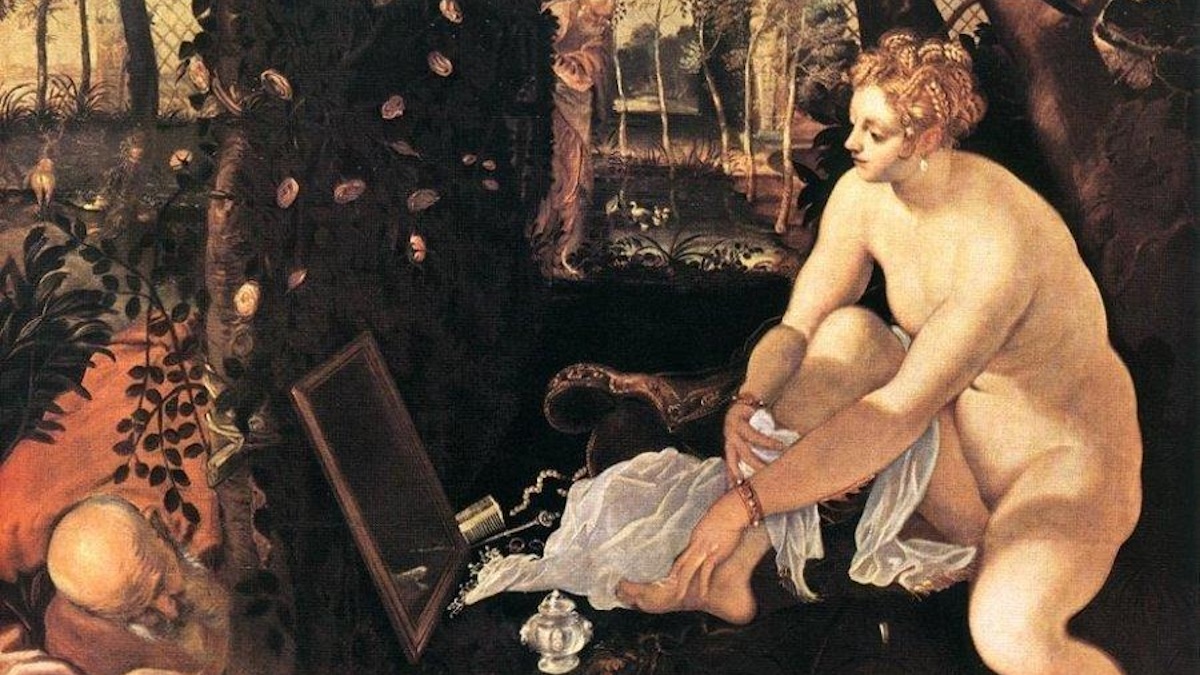
As I traveled deeper and deeper into Natalie’s disordered mind, a 1972 essay by art critic John Berger kept coming to mind. The essay, published at the height of the second-wave feminist movement in a collection titled Ways of Seeing, is a commentary on art from ancient times to the present. Berger argues that women are most often depicted in art as sexual objects, viewed through the eyes of an implicitly male observer. This concept is the basis for what later became known as “the male gaze.”
The male gaze is not merely—or even primarily—an artistic phenomenon. Rather, according to Berger, it is a fundamentally psychological experience, one that fragments a woman’s sense of self. Because women are born “into the keeping of men,” Berger explains, they develop an internal observer, to help them anticipate how men will perceive them. They then adjust their actions and appearance accordingly. In this process, a woman’s self is “split into two,” becoming both surveyor and surveyed. Berger goes on:
Men look at women. Women watch themselves being looked at. This determines not only most relations between men and women but also the relation of women to themselves. The surveyor or woman in herself is male: the surveyed female. Thus she turns herself into an object – and most particularly an object of vision: a sight.
Fifty years and several waves of feminism later, the phenomenon Berger describes has not disappeared. On the contrary, it has only worsened, with acute psychological effects. The number of images women see of themselves—and of other women—has multiplied exponentially since Berger wrote. As Photoshop has been replaced by FaceTune and FaceTune has been replaced by AI, those images have become more and more tailored for consumption and less and less representative of the actual experience of living as a female body.
Today, the implicit observer for whom women perform has multiplied beyond belief. Berger argued that the way that men perceived a woman would determine “what is normally thought of as the success of her life,” and that women respond by grasping at a sense of control by interiorizing the process of being perceived. “Her own sense of being in herself,” writes Berger, “is supplanted by a sense of being appreciated as herself by another.” But now, it is not just her father, suitors, husband, or other local benefactors whom a woman must consider. It is not just men who will survey her as an object of vision. It is, potentially, the whole world, consuming the “content” we create, consuming us as “a sight.”
The Empty, Smiling Self
Natalie’s interior world is like a hall of mirrors. There is Natalie after Natalie after Natalie, looking at each other and critiquing each other’s performance and adjusting and critiquing and commenting and looking again. It’s not clear exactly why or how this internal disorder began, though her mental health clearly worsened drastically after the birth of her first daughter, Clementine. At one point, Natalie briefly considers the possibility that she is the way she is because of her father’s absence during her childhood, but she quickly rejects this too-tidy explanation. She is more inclined to blame her mother—and not without reason.
At one particularly low moment, Natalie calls her mother on the phone and asks her how she managed to be such a good housewife. Her answer takes Natalie by surprise. “Whenever I was reaching my wits’ end,” her mother tells her, “I would imagine I was being watched.”
“I pretended I had a little audience sitting on the couch with me. Watching me vacuum or take out the trash. Cheering me on!”
I felt suddenly nauseous. So that was the secret: all those years I’d spent watching my mother and the other women in our community, marveling at how effortlessly they performed their roles as mother, homemaker, wife; all the moments I’d thought of them at college, summoning their easy joy and holding it in my hand like a lucky rabbit’s foot while the girls in the dorm complained about everything—it was a lie, wasn’t it?
Natalie’s mother teaches her to perform for an invisible yet ever present audience, explicitly training her to cultivate the male gaze, fragmenting herself in the process.
In one of the most heartbreaking moments of the novel, Natalie repeats this cycle. After taking an expensive e-course on how to become an influencer, Natalie tries to follow the other seminar participant’s feedback, who told her that she needed to become more likeable. As she stands in front of her mirror, practicing her smile, her daughter Clementine walks in on her. “Mama?” she says questioningly. “What are you doing?”
Irritated, Natalie answers honestly. “I’m practicing being likeable.” Then, she turns on her daughter. Like her mother before her, she views it as her duty to teach Clementine how to perform. She resists “the very strong urge to press [her] fingers into the clay of her cheeks and drag the ends of her lips upward.” Instead, she says to her daughter: “You’re a big girl now, Clementine. You need to learn how to smile.”
The character of Natalie’s mother, with her playacting of happy domesticity, recalls well-known feminist critiques of 1950s era housewives. Most famously, in her 1963 bestseller The Feminine Mystique, Betty Friedan argued that women’s roles were eroding their sense of self. They plastered on smiles and cleaned their houses and performed for their invisible audiences, but they were empty inside. “It is urgent to understand how the very condition of being a housewife can create a sense of emptiness, non-existence, nothingness, in women,” writes Friedan. “There are aspects of the housewife role that make it almost impossible for a woman of adult intelligence to retain a sense of human identity, the firm core of self or ‘I’ without which a human being, man or woman, is not truly alive.”
While disavowing both Friedan’s “pathologization of stay-at-home mothers” and her pervasive classism, Angela Franks argues in Body and Identity: A History of the Empty Self that Friedan was actually onto something here—something more dangerous and more important than even she knew. It’s the same insight that underlies Burke’s writing. “Friedan does not get much credit,” Frank observes, “for noticing the widespread existence of a culture of narcissism” long before the concept entered the mainstream imagination. Narcissism is something deeper than the way most of us (mis)understand the term—as mere “self-centeredness, self-aggrandizement, or excessive self-love.” Rather, Franks explains, the narcissist’s “pervasive self-centeredness is not the problem in itself but a symptom of the problem. The problem is the interior emptiness that captures one’s psychic energies in defensive countermoves.”
In other words, when you don’t have a stable sense of self, you become obsessed with constructing the illusion of one. You must painstakingly “prepare a face to meet the faces that you meet,” as T. S. Eliot would say. And if your attention is constantly turned inward, observing yourself and attempting to anticipate the reaction that your appearance will elicit from observers, then you are unable to tear your gaze away from your own reflection long enough to look anyone else in the eye. “If you are only a thing,” writes Franks, “everyone else looks like a thing” too.
Franks criticizes Friedan for failing to realize that “‘the feminine mystique’ was only a proximate, not the ultimate, cause of the depersonalization around her.” The same could be said of Burke. Natalie’s obsession with playing the role of the “Good Christian Woman” is deeply disordered, as is her inability to relate to other people as anything other than a faceless audience member or a prop in her performance. But the real problem isn’t Christianity or womanhood, neither of which Natalie understands or embodies in any substantial way. The problem is the emptiness of Natalie’s self.
In this way, Burke succeeds in creating “a satire of women everywhere,” in principle if not in fact. Not everyone has a diagnosable personality disorder, but all of us live in a culture that nudges us toward narcissism. Even those who eschew social media may unconsciously begin to view themselves through the dehumanizing lens of performative commodification. If women do not possess a stable sense of their own personhood, lovability, and inherent worth, they can easily fall into the trap of believing that they must construct one. Grasping at the flimsy premade scripts available to them—are you a girlboss or a tradwife?—such women seek to perform, to please, to play their role so well so that the audience will have to love them. And if love is unattainable, hate will do. It, too, keeps the audience watching, as Natalie well knows.
Although Yesteryear contains graphic descriptions of physical wounds and domestic violence, it is the deep sense of psychological horror that propels the book to its unexpected finish: the fear that Natalie might lose the thread entirely, might forget her lines and thus forget who she is. And, more terrifyingly, the quiet realization that any of us could do the same.
