


In the last decade, we have learned that women’s brains are profoundly transformed by motherhood. Research studies have typically focused on the transition into first-time motherhood, but most mothers have more than one child. In fact, despite the falling birthrate, bigger families are in vogue these days, often considered a status symbol, and the number of Americans who say that their ideal family would include three or more children is at its highest level since 1971. Yet we know surprisingly little about what happens to the brain upon repeat parenthood.
This year, we got a partial answer to this question from the Dutch researchers behind some of the most important studies of the maternal brain. It looks like second-time moms do show additional brain changes, and their patterns of change look different from first-time moms in some very interesting ways. I was one of the expert peer reviewers for their original submission to the journal Nature Communications, so I got a sneak peek and the chance to give my input on the paper last year. I have been eagerly waiting the official publication so I could tell more people about this work.
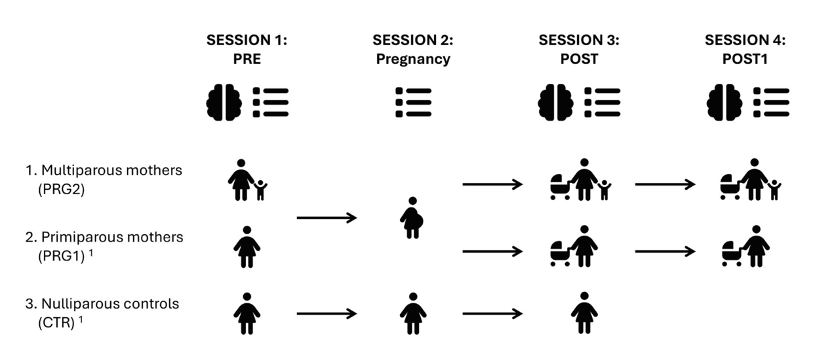
The study looked at three groups of women: 40 moms who were planning to get pregnant for the first time, 30 moms planning their second pregnancy, and a control group of 40 women who were not moms. The researchers used Magnetic Resonance Imaging to take high-resolution pictures of the women’s brains. They scanned all the moms before their pregnancy started (pre-conception), gave them mental health and parenting questionnaires to complete during their third trimester of pregnancy, and then scanned them yet again a few months after their baby’s birth. There was also an additional follow-up scan about a year after the birth.1 The non-moms were followed at similar time intervals as the mothers. Here’s a figure from the paper that illustrates the data collection pipeline.
The big take-away from previous research on first-time moms is that the brain shrinks across the transition to motherhood. In other words, it loses gray matter volume. When you picture a brain in your mind, you’re probably picturing its gray matter, the wrinkly outer layer of tissue in the brain (actually more pink than gray). That’s the part of the brain that gets smaller when women enter motherhood. The volume loss sounds alarming, but it’s part of what scientists consider an adaptive process of remodeling that might streamline the brain to work more efficiently. Supporting this contention, the greatest shrinkage seems to occur among parts of the brain that support social cognition and empathy, and women who lose more gray matter volume in those regions also report a stronger mother-child bond.
This brain shrinkage seems to endure for years after birth, but the overall pattern is U-shaped: after an initial sharp drop in brain volume in late pregnancy, brain size seems to rebound after the early postpartum period, regaining most but not all of its starting volume.
In this new study, the researchers found the “starting brains” of the first- and second-time mothers were not hugely different in size. The second-time mom brains looked a little smaller at the first pre-pregnancy scan, but this difference did not register as statistically significant. This suggests that at some point between the first and second pregnancies, the second-time mothers regained most of their brain volume.
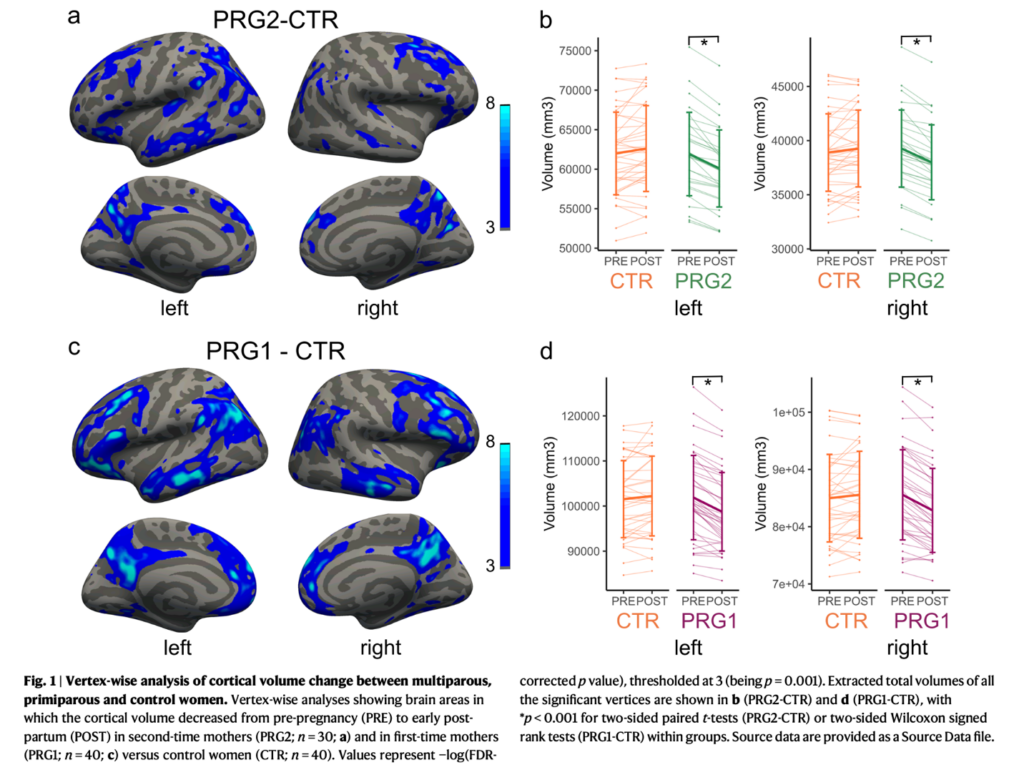
Between the pre-pregnancy scan and the early postpartum scan, on average, first-time moms lost about 3.1 percent of their starting brain volume during their transition into motherhood. Mothers of second children showed a similar pattern, but a smaller number of areas within the brain showed significant change. Across these areas, they lost about 2.8 percent of their starting brain volume.
In other words, the transition into second-time motherhood has an impact on the brain, but it’s slightly less momentous than the change the first time around. The researchers tried feeding all the women’s brain scans into a computer and asking the computer to pick out which women had babies. It could distinguish the mothers from the women in the comparison group of non-mothers about 90 percent of the time. When asked to determine whether the moms had first babies vs. second babies, it achieved 80 percent accuracy—not quite as good, but still pretty impressive, suggesting that the brain changes in some distinct ways across different pregnancies.
This figure, from the published paper, illustrates the findings. On top, you see the areas of brain change associated with a second pregnancy, contrasted with the changes that occurred across the same time span in the non-mother comparison group. On the bottom, you can see the comparison between non-mothers and first-time moms. Both groups show changes, but the first pregnancy group has changes across a larger portion of the brain (shown in blue in the left panel) and the decreases in overall gray matter volume (depicted by the line graph on the right panel) look steeper.
Here’s where it gets interesting. Although the first- and second-time moms underwent fairly similar magnitudes of brain change, they showed different patterns in terms of how and where the brain changed.
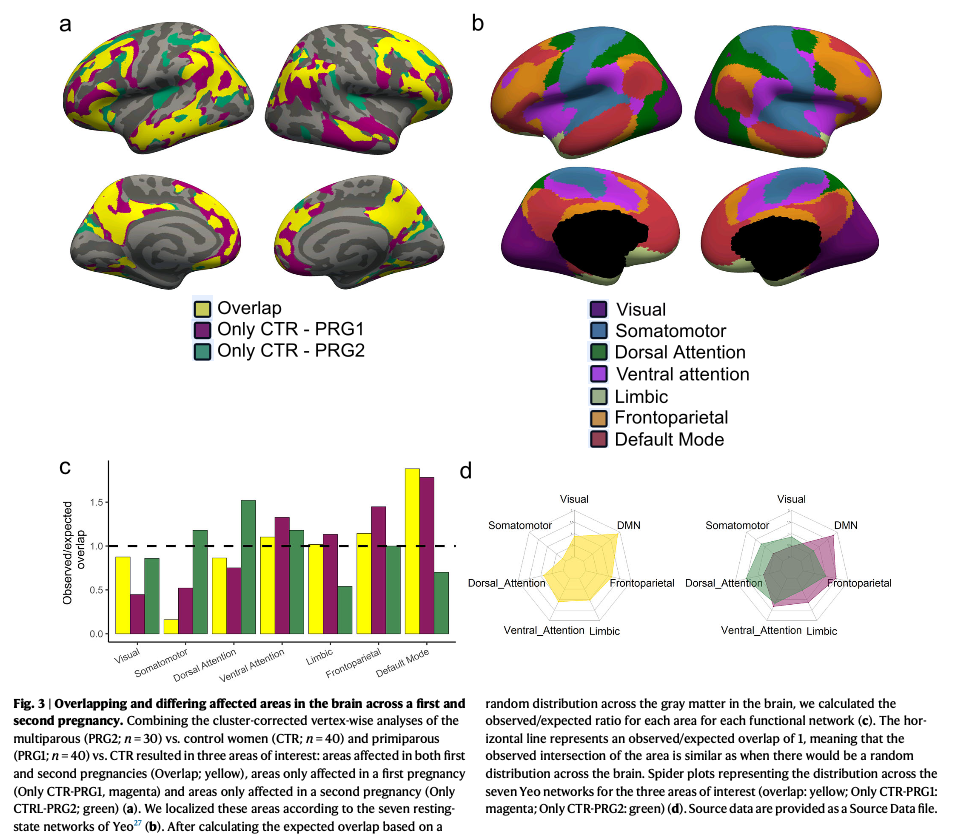
Both first- and second-time moms showed changes in the brain regions that comprise what is known as the “default mode network” (more popularly known as the “mentalizing network,” which engages when we think about other people’s thoughts, feelings, and behaviors), but the first-time moms had more sweeping changes to this network. First-time moms also had more profound changes to a network called the frontoparietal network, considered a “cognitive control network” that helps with executive functioning and emotion regulation. As the researchers wrote, “This suggests a primary adaptation of these networks in women who become a mother for the first time, which is then further fine-tuned in a similar but more subtle way during a second pregnancy.” These areas could all be described as inward-looking: they shape how we think. They help us consider other people’s minds and use our own mind. When we imagine how our non-verbal baby might be thinking or feeling, we’re using our mentalizing network. When we’ve been up all night tending to a fussy baby who startles us awake yet again, we must recruit our cognitive control network to override our frustration while we calmly soothe the baby back to sleep.
In contrast, the areas that showed more specific change over a second pregnancy were in networks that help us pay attention to the outside world. These include the visual network, the somatomotor network, which helps us sense and move, and what is called the dorsal attention network, which helps us track information that serves our goals. Imagine that you’re at a crowded family restaurant and your oldest child insists on going to the bathroom alone. The dorsal attention network allows you to stay focused on tracking your child’s movements and listening for the sound of their voice, despite all the commotion in the restaurant. Taken together, these three networks are linked with goal-oriented attention, responding to external stimuli, and getting things done. The researchers write, “These changes can be speculated to prepare a woman for the increased demands associated with caring for multiple children at the same time.”
Here’s a lovely figure from the original paper that shows the brain regions that changed most in first-time moms (in magenta), most in second-time moms (in green), and overlapped across both cohorts (in yellow). As you can see, there was more overlap than distinct change, suggesting the maternal brain transforms in similar ways across multiple pregnancies, but those visual, somatomotor, and dorsal attention networks seemed to sharpen the most in the second-time moms.
To simplify the overall take-home message of the study, we could say that first-time motherhood is about reorganizing our internal sense of self, whereas second-time motherhood is about staying on top of outside demands. There’s more to do, and we need to deploy our attention in multiple directions.
Although this paper makes a great contribution to the research literature on the maternal brain, there is still so much more to learn. What happens between a second and third pregnancy? What about mothers who have more than four children? There is some new evidence that having had more children is beneficial for the brain aging of both mothers and fathers—that is, that the number of children is correlated with markers of a younger-looking brain. However, these studies find that the greatest benefit emerges in parents with two or three children, after which the parenting-associated brain boost seems to level off. Based on this work, it’s likely that a fourth or fifth child doesn’t reshape the brain quite as much as a first or second child does, but we don’t know for sure.
Regardless of the continued questions, it’s clear from the evidence so far that the maternal brain is an amazing instrument. It remodels to fit the demands of motherhood in ways that make it more responsive, more flexible, and more agile—just like mothers themselves.
- Sadly, only a handful of women were able to participate in that late postpartum scan, because the COVID-19 pandemic got in the way of data collection, so the researchers did not report many results from it. ↩︎