

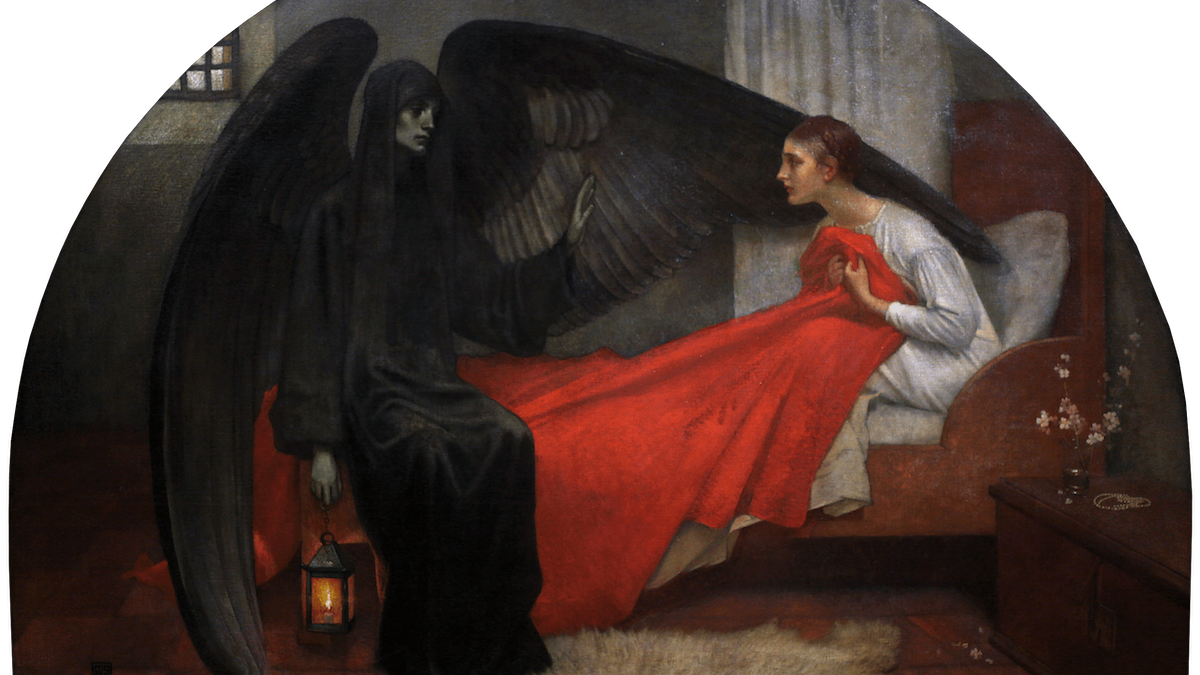
It’s a too-hot day at the end of June 2025. I’m in Strasbourg, sitting in the back of a packed room at the European Society for Child and Adolescent Psychiatry’s conference and watching a panel of Dutch psychiatrists squirm as they defend the expansion of medically assisted death services to “mature minors” suffering from mental illness. The program had framed the proceedings as a debate, but it unfolds like a freshman philosophy seminar: a forum not so much for serious questions as abstract musings, quelled by a figure whose fragile presence inhibits any real discussion.
You can tell how conflicted the clinicians are about what they are doing. They duck their heads and wring their hands. They cannot hold the audience’s gaze. They stress over and over again how euthanasia is not a right, that a doctor is free to refuse any patient her request to be euthanized or to refuse to participate in medically assisted deaths altogether. They note sharp spikes in applications for euthanasia in the wake of media coverage—and how often adolescents and young adults later retract their requests. They acknowledge how rapidly and unpredictably a young person’s circumstances can change (“so how can one tell whether there is no possibility of change in a young person’s condition? Is unbearable suffering truly hopeless?”), how young people’s brains are still forming, and how the “wish not to live cannot be equated to the desire to be dead.”
The clinicians warn that “the existence of euthanasia may undermine psychotherapeutic attempts, as well as the patient’s own capacities for resilience and hope” and put patients who are already struggling with their mental health in a position where they “must justify the decision to continue living,” rather than simply living by default. One clinician wonders: “Aren’t we asking the impossible of our young patients and ourselves with medical assistance in dying on the table?” It’s a question nobody involved can afford to answer.
Then an “expert by experience”—which is to say, an applicant for euthanasia—rounds out the panel: a young woman with a soft voice and scars up and down her arms. She tells us about the darkness inside her that surges and retreats, from which she has so far found only the most temporary relief. She describes her relationship with the euthanasia team as the first time she has ever felt like anyone was “walking with her” in her illness: not trying to “cure her,” not sitting in judgment of her desire to die. She assures us that the clinical team will “help” her for “as long as they can,” but it’s clear that, someday, she intends to walk through that door. She begs the audience not to lock it.
This strikes me as the right metaphor: the door that is now open. It is right that such a metaphor be double-edged. I can picture the open door as a quiet retreat, like a fire escape. But I can also feel the icy winds it admits. In other words, everyone must live with the choice of whether to walk through that open door or merely live with the drafts that blow through it.
In a debate that has often evaded the stakes involved, Kathleen Stock’s new book, Do Not Go Gentle: The Case Against Assisted Death, reckons with the society-wide desensitization process that the campaign for “Big Assisted Death” has set in motion.
When it comes to medically assisted death, almost everybody softens their language, backs away from the implications, and retreats into the passive voice. It’s uncomfortable to speak frankly. I am uncomfortable speaking frankly. It’s not just the presence of death that makes us uncomfortable, although death does tend to have that effect. It’s the uncertain new ground we find ourselves on. We don’t feel we have the standing to judge an individual’s desire to die. We don’t want to level accusations, no matter how ill at ease we may feel. All the ordinary language one might use to object has been turned upside-down. What does it mean to be bound, free, merciful, cruel? Writing this review, I catch myself in polite evasions that come to me even in a stance of severe disagreement. I don’t want to say “kill.” What accusation could be more serious?
Stock rejects the framing of assisted death as “just” a medical procedure: “Whatever the rights or wrongs of assisted death, insofar as it involves deliberately causing premature death, it is never ‘just’ a procedure (and nor, for that matter, is it medical).” As with other hot-button social issues like abortion (“abortion is healthcare”) and gender-affirming care (“trans rights are human rights”), advocates for assisted death attempt to cut out the knot at the center of the debate. Stock lets no one off easy, dismantling the evasions and challenging the ways medical providers of assisted death disown the active role they play. Stock quotes a physician who reduces herself to an instrument in the hand of a patient at the very moment that she actively ends that patient’s life: “I had to remind myself it was [the patient’s] disease that was killing her and my role was only to facilitate her free will.” Assisted death, Stock reminds us, “is a joint project by definition.”
Throughout the book, Stock makes the case that the normalization of assisted death “could never be just a discrete event.” Rather, the promotion of assisted death will undermine social taboos, hang an abacus over all our heads, and bring down state-sanctioned social disapproval on those who stubbornly insist their lives have value and want to live on, in spite of their debility and dependence.
I moved to Canada a few months after the country’s Medical Assistance in Dying program—which bears the dystopian nickname “MAID,” with its implications of discreet tidying up—was amended to “repeal the provision that requires a person’s natural death be reasonably foreseeable in order for them to be eligible for medical assistance in dying,” and as Canada debated the further expansion of the “right to die” to people struggling with mental illness. MAiD quickly became a dark joke in a country where medical services were stretched to the breaking point and tens of thousands of Canadians were dying while on the waitlist for medically necessary surgeries. A viral meme presented a stick figure in need of stitches seeking medical care in the United States (“That’ll be $58,000”), the United Kingdom (“I can help you in 38 months”), and Canada (“Kill yourself”).
Friends navigated a strange new world of mourning, in which they were supposed to be grateful for a loved one’s release—so enlightened, not to have to suffer at the end of life—while at the same time retaining feelings from an earlier age of human consciousness—namely, the sense that they had been robbed of precious time together. Meanwhile, the news was full of things that Never Happened: patients seeking help to make their lives more livable; doctors suggest-selling death; patients telling reporters they were opting for MAiD because they were lonely, unsupported, or simply could not afford to live any longer.
There is little overlap between the real world where medically assisted death services are being implemented and the imaginary world, miraculously free of all forms of coercion, of which its advocates speak. Their indifference to the actual conditions in which such services are and will be implemented can be shocking. Perhaps coercion will shove a few unlucky grannies into an early grave, but it’s all for the sake of the greater good.
Advocates of medically assisted death define themselves by their compassion. Yet, for all their talk of autonomy and mercy, they exhibit precious little empathy. Real empathy requires curiosity about an individual’s actual experience, not mere deference to his stated wishes. The question must be: why does this person want to die right now? There are no “one-dimensional” stories here. Stock lays out the inadequacy of an individual’s desire for assisted death against the moral weight of administering such a death, writing:
Suffering individuals don’t always know how best to help themselves, and sometimes do things which are positively counterproductive. We are looking for a moral justification for a doctor to help end somebody else’s life. With an outcome that final, it had better be a robust one. It can’t just be ‘because he said he wanted it.’ Mercy (or its modern counterpart, compassion) is aimed at the provision of genuine help and relief to others, not just its superficial appearance.
One wonders what a “safe, responsible assisted death service” might look like. Stock again:
The answer is: very expensive and time-consuming. There would have to be in-depth investigations before every decision, with officials given enhanced inquisitorial powers to draw upon a large range of evidence. There would also be secondary requirements: dedicated training and skills testing for all involved, regular audits, scrupulous record keeping, and so on. And there would have to be enhanced managerial oversight of any doctor-patient relationships, though how to achieve this is unclear.
Spelling this out perhaps makes clear why legislators don’t seriously try to address the issue. Namely: they know they can’t possibly afford to.
The way these services now operate, it is inevitable that doctors will be complicit in “preventable, unfree deaths” that the service is unprepared to detect, much less deflect.
The parallels to another focus area of Stock’s—the explosion of young people adopting transgender identities and seeking transition—are clear. Not all that long ago, the would-be transsexual walked a lonely road. He needed to mobilize considerable psychological and financial resources to realize his unusual desires. That world is no more.
In both realms, activists operating within and outside the medical profession have dismantled the safeguards that once stood between troubled patients and life-altering interventions. Supply has begotten demand. Evidence of harm has mounted. Debate has faltered under the weight of euphemisms, wishful thinking, and the testimony of patient-advocates no one wishes to contradict. In both cases, we see an extreme of toleration that refuses to say what is good or bad for human flourishing and what is responsible or irresponsible for doctors to do in the name of medicine.
Throughout the book, one feels the loss of beliefs and rituals that once structured and eased the end of life. In the absence of these sources of guidance and solace, we may be tempted to seek control—to flee from pain made meaningless, delimit our suffering, and determine in advance the date of our deaths.
The vision of life and death that advocates for medically assisted death promote is disconnected from social traditions that value human life regardless of all other considerations. Against that backdrop, some of the most moving passages in the book resurrect a reverence toward life that in many ways already feels outmoded. Stock revisits the life’s work of Cicely Saunders, who founded England’s first modern hospice with the philosophy that hospice staff “will do all that we can not only to help you die peacefully, but also to live until you die.” She writes evocatively of the screenwriter Dennis Potter and the vividness of the world he encountered in the last days of his life (in his words: “the nowness of everything is absolutely wondrous… the fact is, if you see the present tense, boy do you see it”). She tells the story of the doomed Russian poet, Osip Mandelstam, who refused his wife’s offer to end their lives together with the words: “Life is a gift that nobody should renounce.”
How far we have already traveled.
Back in Strasbourg, the clinicians repeatedly express the gravest concerns about what they are doing, while also insisting that it would be wrong—inhumane, in fact—to even think about stopping. The patient they put in front of us, as if to mute our questions and protests, cannot imagine that her suffering will ever change in any meaningful way. If these doctors were to take away the option of euthanasia, they would revoke the promise they made to her: that she will not have to die alone, if and when she wishes to end her life.
Does that mean a doctor should euthanize her?
Why is it so hard to retrace our steps when we have strayed into dangerous territory? Once imagined, the future is painful to retract. Each step forward promises to absolve the step that preceded it. It’s easy to lose sight of where the road we have set out on leads. In Do Not Go Gentle, Stock offers us an opportunity to look with clear eyes at where we are going before it is too late. With assisted death, there is no going back.
Do Not Go Gentle by Kathleen Stock is available today.