

I celebrated the death of wokeness as much as the next baddie. At long last, we were allowed to say that men weren’t women without being ejected from polite society. But alas, no party is perfect. Unwelcome guests have a way of showing up and sullying the festivities.
In the wake of Donald Trump’s 2024 reelection, more and more people began to argue that the feminist movement had been a mistake from the start. “Feminism didn’t ‘liberate’ women,” one “Gen Z conservative” named Faith Merrill wrote on X recently. “It turned them into miserable, childless corporate drones who hate men and resent their own biology.” She goes on:
Record single motherhood, skyrocketing depression, and a generation of weak boys raised by single moms. This isn’t progress. It’s demographic suicide disguised as empowerment. When do we admit that feminism was the biggest psyop against the West?
Similarly, Christian right influencer Karoline Gosling announced, “Obviously, the feminist experiment has failed,” adding:
You gave us all we thought we wanted. Right to vote, right to work, right to bank accounts, right to unchecked divorce. What happened? We are more unbearable as a gender than ever. We are more depressed than ever. And we are more victims than ever. Also, the world has developed a deep hatred for us. We must end feminism now.
I, too, have had a lot to say about the misguided positions adopted under the umbrella of “feminism” in recent decades. These include everything from mantras like “sex work is work” and “trans women are women” to the elevation of “intersectionality” as the true purpose of feminism, which led to identity politics overtaking the movement. Yet I believe that it is essential to distinguish between the failures of a particular form of contemporary feminism and the history of the feminist movement as a whole.
The women’s movement was not rotten from the start. Indeed, for most of its history, it was quite rational. Extending the fundamental premise of Western democracy to women as full human persons with dignity and rationality equal to those of men is something that differentiates the West from the oppressive and authoritarian regimes that have existed and continue to exist in other parts of the world. By all means, criticize the excesses, mistakes, and pure nonsense that is third-wave feminism. I certainly do. But discounting or attempting to undo the essential progress made by the first- and second-wave feminist movements is misguided and ignorant.
Third-Wave Problems
Modern feminism’s poor reputation is, in large part, due to the movement’s third wave—the iteration that began in the 1990s and continues to define “feminism” today. This wave brought intersectionality, queer theory and gender ideology into the mainstream, popularized the claim that pornography and “sex work” can empower women, and cemented the dogma that any choice a woman made was an inherently feminist one. Third-wavers turned “white cis woman” into a slur, then silenced and vilified any female who dared offer an accurate definition of the word “woman” itself. Indeed, they refused to centre “women” at all. We were to speak of “gender,” race, disability, fat, and myriad other invented identities. Simultaneously, casual man-hating became the norm.
By the 2010s, third-wave feminism had become the dominant ideology in Western culture. It was expected for men and women alike to identify as feminists. Those who didn’t were assumed to be and even labelled as misogynists. The idea that there were few to no differences between men and women was pushed as the correct and forward-thinking view. Female athletes? Just as talented and as entertaining as male athletes! Female soccer and basketball players should make the same amount of money and receive the same levels of fame as men, despite their lack of ticket sales. Fewer female pilots, engineers, and firefighters? There couldn’t possibly be a rational reason for this; therefore, the disparity should be corrected by coercive policies. The suggestion that women might not benefit from having strings of one-night stands—that they might actually be inclined toward security and commitment—was treated as a regressive remnant of Puritanism rather than a plain description of reality.
In 2017, Google engineer James Damore became one of the first and most famous victims of cancel culture after penning a memo titled “Google’s Ideological Echo Chamber.” There, he suggested there might be innate differences between men and women that would help account for female underrepresentation in tech. “Nearly every difference between men and women is interpreted as a form of women’s oppression,” he wrote. He wasn’t wrong. Yet he was excoriated across the internet, fired from his job at Google, and de facto banned from employment in his field.
Around the same time, the #MeToo movement made it acceptable to post vague but serious-sounding accusations about any man online, sentencing him to ostracization and career death. We were told that we must not ask for evidence; we must “believe all women.” When I dared to ask questions about allegations against a Canadian man named Steven Galloway, head of the University of British Columbia’s creative writing department when he was accused of assault by a former (adult) student with whom he’d had a (consensual) affair, I was treated as an enemy to the feminist cause. The allegations were never supported, and no evidence of any assault ever came to light. In truth, there was no assault. Yet, without any information or evidence, the media, the university, and Canadian feminists and progressives treated it as an open-and-shut case. Galloway’s career and reputation were destroyed. Anyone who suggested due process was in order was cancelled along with him.
A backlash was bound to come—and rightfully so.
For decades, women have been told to wait until they have solidified a career and financial security to settle down and have a family, only to learn that biology doesn’t care about ideology, and if you wait too long, you miss your window. Biological and social differences between men and women were cast aside, labelled as sexist. In other words, women were sold a load of lies, under the guise of “feminism.” I’m glad that more and more people are realizing this, and that those lies are being more and more broadly rejected.
Yet this rightful reckoning does not mean that we must roll back everything achieved in the name of women’s rights. Neither the first- nor the second-wave feminists believed that prostitution was good for women or society, nor did they shy away from biological truths about women and men. They fought against genuine oppression and violence against women.
The Foundations of Feminism
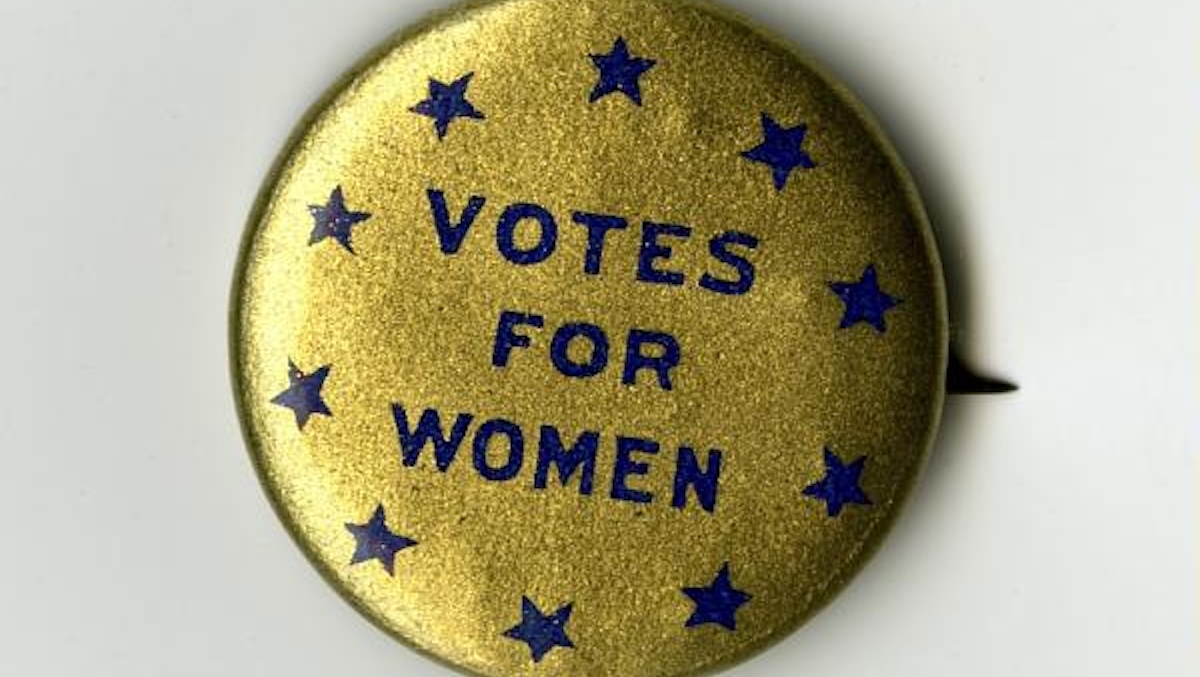
Third-wave feminism and the excesses of the #MeToo movement are a far cry from the original women’s movement. For most of the movement’s history, women fought for agency, rights, and independence in practical ways. They lobbied successfully for laws criminalizing marital rape and sexual harassment in the workplace. They established women’s right to own property, to have a credit card, to go to university, and—of course—to vote.
Manosphere streamers, heterodox men, and conservative influencers have managed to lump more than 250 years’ worth of complex and competing forms of political and social theory and practice into one undifferentiated pile, to be consigned to the trash heap. In reality, undermining the legal equality of women would not make Western society stronger or return it to some imagined bygone age of greatness. On the contrary: a society that does not allow women to vote, receive a full education, have a voice in politics, and charge rapists (including their husbands) with a crime is not a democratic one; it is an authoritarian and barbaric one.
Patriotic Americans surely value the 250-year-old Declaration of Independence. So did famed suffragist and women’s rights activist Elizabeth Cady Stanton. In 1848, in collaboration with abolitionist Lucretia Mott, she drew upon its principles to argue that, as full human persons, women deserved equal treatment under the law. In the Declaration of Sentiments and Resolutions presented at the Seneca Falls Convention, they wrote:
In view of this entire disfranchisement of one-half the people of this country, their social and religious degradation, in view of the unjust laws above mentioned, and because women do feel themselves aggrieved, oppressed, and fraudulently deprived of their most sacred rights, we insist that they have immediate admission to all the rights and privileges which belong to them as citizens of these United States.
At the time, women had limited property rights, were not allowed to vote in national elections, and were generally excluded from the universities (though several “female seminaries” and a handful of women’s colleges had opened by then). Their husbands could rape and beat them with impunity and institutionalize them with little real oversight. Men held every advantage in divorce and child custody. Women truly could not operate as agents of their own lives. The history is often glossed over, but first-wave feminists fought for nearly 75 years before they won the right to vote. Many of these other rights took even longer. Marital rape, for example, was legal in all fifty states until Nebraska criminalized it in 1976. It took until 1993 for the final state, North Carolina, to repeal its spousal exemption.
Beginning in the 1960s, second-wave feminists addressed the problem of women’s unequal treatment in society, along with ensuring the equal protection of women’s rights under the law. Male violence against women remained a huge problem in liberal democracies, and feminists spoke out against domestic abuse, rape, pornography, and sexual harassment. It would be rather ironic for those sounding the alarm about men coming from misogynist, regressive cultures like Somalia and Pakistan raping and abusing women and girls in Western countries to argue against women’s rights in America. Yet without the feminist movement, American women would be suffering similar abuses at the hands of Western men.
I have already detailed many of the failings of third-wave feminism. It is true that many strands of feminism have tended to be overly skeptical of the findings of evolutionary biology, and that many feminists are deeply uncomfortable with the idea that men and women might, on average, exhibit differences in behavior, preferences, and aptitude. Yet it is also true that not all empirically observable sex differences are the result of biology. Many are indeed “socially constructed,” despite that term’s widespread misuse.
Girls are socialized to be quiet, not interrupt, and to wait their turn, while boys are taught not to appear vulnerable, either emotionally or physically. Girls do learn that f*ckability is their primary value. Boys learn that consuming pornography is a normal part of growing up, and that they can and should coerce girls into performing their pornographic fantasies for them, via the sending of nudes and violent sex acts.
There is nuance here, to be sure. But the internet doesn’t like nuance. So, instead, we got about fifteen years of “feminist” dominance, followed now by a large faction of influencers insisting that women’s rightful place is solely in the home, that we are not equipped to vote (men can take care of this for us!), and that feminism is the scourge of the earth.
Both approaches are wrong.
It makes no sense to claim to be “protecting Western culture” while also arguing that feminism has ruined Western culture. As Josephine Bartosch recently argued here in Fairer Disputations, Western culture is remarkable precisely because it declares that all human beings—regardless of their sex, their physical strength, or their political power—possess equal dignity. The rise of Christianity cemented this concept, raising the status of women along the way. Women, in turn, proved to be a formidable force for social change, calling on men to live out the values they claimed to hold. Bartosch writes:
It is revealing that so many commentators are prepared to believe women’s moral instincts changed society for the worse but never for the better. Was the campaign to abolish slavery “woke”? Was the introduction of the age of consent “woke”? Was universal suffrage “woke”? Each emerged, at least in part, from traditions of moral concern and care for those on the edges of society. Viewed through the lens of evolutionary psychology, all could be dismissed as the product of women with displaced maternal instincts somehow exerting immense cultural power. Yet these are now regarded as the moral foundations of civilisation itself.
If women are to be blamed for the culture, then they must also be credited for its conscience.
The existence of our freedom, equality, and democracy depends upon the women’s movement and its accomplishments. There is no democracy if we don’t all have a voice. There is no freedom if half the population isn’t actually free.
Yes, when women have choices, they might make bad ones. The same goes for everyone. There are legitimate ways to try to help form men’s and women’s characters in such a way that they will use their freedom well, in ways that encourage their personal flourishing and that of society at large.
Undermining women’s legal equality is not one of them.