

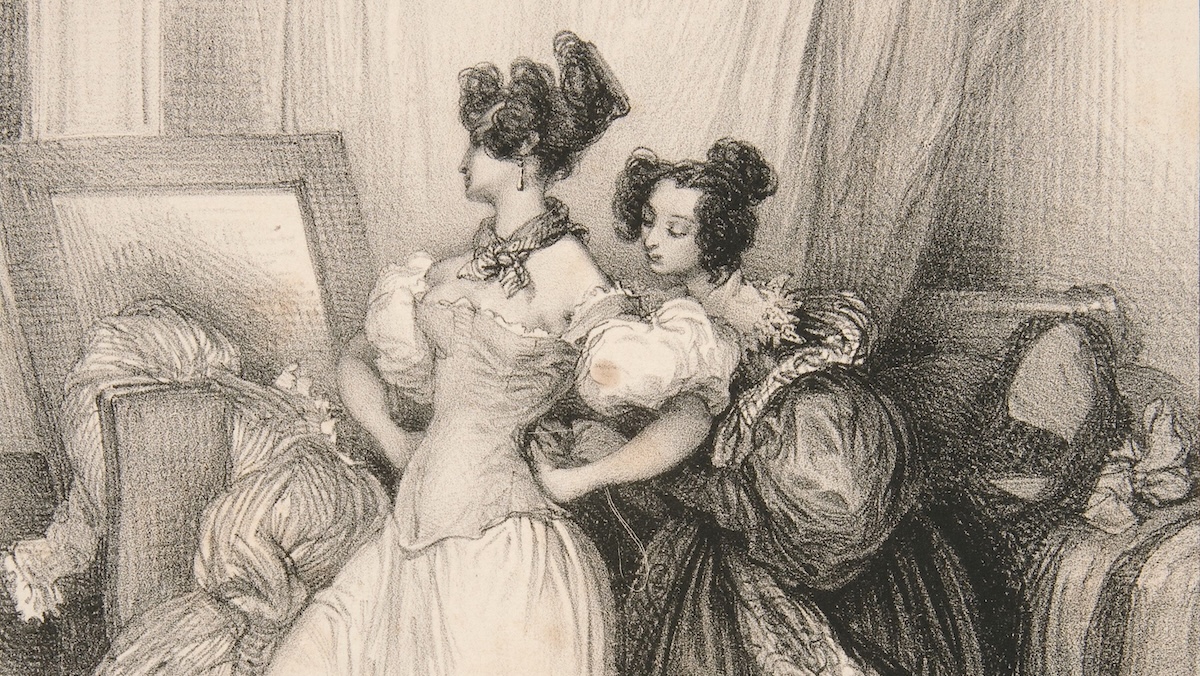
When I was a senior in high school, our substitute English teacher showed up to class with Play-Doh. We were supposed to create a scene representing A Doll’s House, the famous Ibsen play. Why she considered this a fruitful use of time for a bunch of eighteen-year-olds is beyond me. My group decided to make a figurine of Nora, the tragic protagonist who eventually leaves her husband and children. She sported a voluminous skirt and had a featureless face because, as my classmate put it, “Victorian women weren’t allowed to express thoughts and emotions.”
That’s fairly representative of how contemporary audiences view women from the past: oppressed, repressed, and encumbered by impractical clothing. But is it true?
The way that women’s relationship to their clothing is represented in historical dramas gives us important clues about our contemporary anxieties about female oppression. TV shows and films set in past eras often depict uncomfortable clothing as a subtle means of subjugation, compared to which the modern female experience appears much more liberated. Yet a closer look at both what real women wore in the past and the beauty standards that are currently applied to modern women reveals that there’s more to the story.
Underneath their surface-level critique of impractical historical clothing, many contemporary films exhibit the persistent tendency to sexualize women in the name of feminist empowerment, motivated by deep-seated disgust for the fertile female body.
The Corset and the Crinoline
The history of costume dramas follows the history of feminism’s waves. Film and TV have been utilized to channel ideas about the female experience since Hollywood’s golden age. Most of the time, this takes the form of showing a young woman in a tightly laced corset to signal patriarchal oppression. Perhaps the most recognizable image of tightlacing is Vivien Leigh’s iconic Scarlett O’Hara in Victor Fleming’s adaptation of Gone with the Wind (1939). In the 90s, we saw Kate Winslet struggling to breathe as her Edwardian-era corset was laced progressively more tightly in Titanic (1997). In the 2000s, Keira Knightley’s character in Pirates of the Caribbean (2003) is forced into a corset laced so tightly that she faints, falling off a wall into the sea and almost drowning. Later in the film, she tells a pirate, “Do you like pain? Try wearing a corset.” In Emerald Fennell’s recent adaptation of Wuthering Heights (2026), Margot Robbie’s Cathy has her corset laced with such violence that we can see beads of sweat trickling down her back. Simone Ashley, who played Kate Sharma in the wildly popular Bridgerton, reported that she couldn’t eat in her corset without feeling sick.
But just how harmful were corsets? A 2015 study by anthropologist Rebecca Gibson analyzed female skeletons from 1700–1900 and found that, while the skeletons showed a misaligned spine as well as a deformed ribcage, those women also exceeded their life expectancy, meaning that it cannot be proven that corseting led to earlier death for women on average. Nor did all women “tightlace” to achieve a slimmer waist. A majority of women wore corsets for supportive rather than aesthetic purposes. In fact, corset-wearing is sometimes prescribed even today to alleviate back pain. Worn by the working classes as well as by the aristocracy, women could engage in manual labour while wearing corsets. They could even be altered to be worn throughout pregnancy and breastfeeding, not unlike modern nursing bras. Properly tailored corsets were not causing women to faint left and right.
Even so, were they used as a tool of patriarchal oppression? Here, too, the evidence is weak. The assumption that women’s clothing choices have always been dictated by the patriarchy is an interesting one. Throughout the eighteenth and nineteenth centuries, satirical cartoons drawn and published by men lampooned extreme female fashion trends, including overly tight corsets. This makes it difficult to claim that men coerced (or even encouraged) women to be physically uncomfortable as a tool of control. We would have to argue instead that corset-wearing is a form of internalized misogyny, with women trying to conform to a hyperfeminine ideal of what kind of body is most likely to meet with the approval of the male gaze (i.e., an impossible waist-to-hip ratio, not unlike the heavily surgically altered members of the Kardashian family).
This is hard to prove, however, because clothing has always been a means of communicating gender identity as well as many other aspects of identity, from class to individual self-expression, in complex and overlapping ways. In some cases, such as when wearing a properly fitting corset, clothing can have a practical function rooted in biological differences between the sexes. Often, however, clothing has been more a matter of convention. For example, some men in the past wore a form of corset, too, specifically a girdle. Famously, King George IV used a girdle to minimize the effects of his rather indulgent diet. Men also used to wear heeled shoes as a display of status; King Louis XIV of France, for example, wore high-heeled riding boots. Clothing trends have always blended practicality with symbolism, and have at times been highly uncomfortable, but not for women alone. I doubt men now find it comfortable to wear a suit and tie to a summer wedding, for example. We can’t quite argue that discomforting style is for women alone.
Even so, I think if we make a case for internalized misogyny we get a little closer to the truth. It is undeniable that at different points in history women wore uncomfortable clothing in the name of pursuing an ideal of female beauty. A phenomenon which costume dramas have largely neglected, but I think is far more damning evidence of Victorian beauty standards than corsets, is the trend of the crinoline. Voluminous to the point of absurdity (see here for an amusing 1860s sketch of a crinolined lady attempting to walk down a flight of stairs), skirts worn over the crinoline cage were prone to catching fire over an open fireplace. During the 1850s and 1860s, crinolines are thought to have been responsible for around 3,000 deaths. Emily and Mary Wilde, Oscar Wilde’s illegitimate half-sisters, famously died of crinoline fire in 1871 at a ball. Crinolines, not corsets, would seem a much more relevant example of women being harmed in the name of beauty.
Yet depictions of this particular form of (self) oppression are few and far between in costume dramas. The obvious, practical explanation is that inserting a death by crinoline into a costume drama plot is objectively harder than just shooting a few seconds’ worth of an attractive young actress pretending to swoon in a tightly laced corset. But it’s a lot less sexy, too.
The Sex-Positive Lie: The Sexualized Body is Not an Oppressed Body
And that, I think, is the point. While films and TV shows set in the past often remind us (whether consciously or not) of how wonderful it is that women are now liberated, in every single one of the examples I cited above, the female body is sexualized, even as the “corset scene” in question would have you believe that it is making some kind of grand, profound statement about female oppression.
In the case of film and TV, if the camera lingers on a close-up shot of a woman being tightened into a corset, can we really argue that the woman in question is not being objectified, regardless of whether the intention was to critique the patriarchy? The most obvious example is the recent adaptation of Wuthering Heights, in which Margot Robbie’s Cathy is seen being tightlaced by Nelly, her maid. Presumably for the sake of added sexiness, Cathy is not wearing a chemise (think a sort of thin, cotton nightgown). Rather, the corset is tightened directly against her skin. In an attempt to make a point about how marrying a rich man whom she does not love is leaving her feeling trapped, the script has Cathy ask to be laced progressively more tightly as she breathes heavily. Is this feminist filmmaking or simple sexualization?
That’s why historical accuracy in costume dramas matters. I don’t say this to be pedantic. If you do not know your source material well—or if you choose to ignore it—you will always end up revealing your own contemporary prejudices. The “real” Cathy (that is, a woman living in Yorkshire in the late eighteenth century) would have worn a chemise, which would have made the corset much more comfortable. In fact, she wouldn’t have worn a corset at all, but rather what was known as “stays,” which could be laced at the front, thus not requiring a maid’s help at all. If we’re going to make claims about women’s lack of agency in the past, we should at least be getting our facts right.
Even ignoring the historical inaccuracy, the scene reveals not only that we have become desensitized to the female body being scrutinized on screen, but also that the moral implication of such depictions hinges on the choice of the character in question. In this particular scene, we are meant to view the corset as oppressive because Cathy is wearing it to conform to societal standards. But in an earlier scene, where a minor character named Zilla puts a horse bridle over her head to have weird BDSM sex with another servant, there is no hint that we are meant to feel repulsion, because Zilla consented.
This is hardly surprising. Decades after any kind of structured undergarments stopped being the default choice for the average woman, corsets have now survived almost exclusively as a symbol of sexual availability. Today, the only places where they can be purchased are shops specializing in lingerie. If we are to judge the war on the corset by its fruits, then it has failed women. Though we may have access to clothing that provides comfort and mobility, we still experience social pressure to wear impractical and uncomfortable clothing in many contexts (such as high heels at formal events). Rather than being able to easily buy a well-fitted supportive corset to relieve back pain or other physical discomfort, we are only given the option of whether to sexualize ourselves or not.
The Motherhood Void: A Fertile Body is an Ugly Body
In short, while blaming supportive undergarments as a physical manifestation of patriarchal oppression is a tidy explanation, it’s not quite the truth. The problem isn’t only that this claim is so often used to justify sexualization. It’s also a convenient way to deflect attention from our own distinctly postmodern forms of misogyny—most importantly, our persistent refusal to view the fertile female body as anything but ugly.
In an article in Smithsonian Magazine, historian and author of Dress in the Age of Jane Austen (2019) Hilary Davidson points out precisely that this kind of presentism obscures our own contemporary practices and beliefs about the female body. We think of corsets as something “strange and unusual and in the past.” In fact, Davidson argues, “We don’t wear corsets because we’ve internalized them. You can now wear whatever you like, but why does all the Internet advertising say ‘8 weird tricks to a slim waist’? We do Pilates. Wearing a corset is much less sweat and effort than going to Pilates.” The means have changed, but the obsession with the perfect body remains.
In the second of the two corset-tightening scenes in Gone with the Wind, Mammy fails to tighten Scarlett’s waist down to her desired eighteen and a half inches, only managing to reach twenty. Mammy tells her there’s nothing to be done, because women’s bodies change after having a baby, but Scarlett won’t have it: “I’m just not gonna get old and fat before my time,” she says indignantly. Though the story is set in the nineteenth century, Scarlett’s fears display a distinctly twentieth-century sensibility. Before contraception became widely available, the pregnant and postpartum body was a ubiquity. I do not say this to romanticize the past—I am very happy to live at a time with lower infant mortality rates and widely accessible painkillers—but rather to remind us of the tradeoffs involved. As pregnancy has become a less frequent experience for women, we have become progressively more accustomed to seeing the “maidenly” body as the default female body.
If, as a woman who discerns marriage, you anticipate that you might bear several children, then the expectation that you should look the same before and after is ludicrous. Many women’s abdominal muscles separate during pregnancy. Fat distribution changes. Many women’s waist-to-hip ratio is permanently altered. Of course, women can be just as healthy in their mothering bodies—this is not a question of weakness—but their bodies will most likely refuse to look exactly the same. If you have grown up with few or even no siblings, and have never seen a pregnant woman in your day-to-day life, it’s hardly surprising that you should be shocked at the changes which women’s bodies experience. It’s hardly surprising that you should want to reverse those changes, too. And that’s precisely what many contemporary women are doing.
All Scarlett O’Hara had was a corset. And yes, she used it in exactly the way that did lead some Victorian women to have negative health consequences. But it was just a corset, nonetheless. In place of that, women now have much more permanent tools to erase the perceived ugliness of their motherhood: they have the technology to alter their bodies both surgically and chemically. Tummy tucks hide the evidence of loose abdominal muscles; breast lifts remove excess skin gained as a result of breastfeeding. Prescriptions of weight-loss-inducing GLP-1 medications for postpartum mothers are on the rise. For now, these procedures are expensive enough that they are limited to the middle classes and above. But as with all new forms of technology, they are likely to become cheaper with time. What then?
As Davidson put it, we don’t need corsets anymore because we’ve internalized the change. Except I would go even further. It’s not just Pilates anymore: it’s the transhumanist urge to optimize the body. The fertile, vulnerable, dependent body just doesn’t fit in this new reality.
We often look to the past for reassurance that progress has occurred since then. But perhaps, when it comes to beauty standards, what costume dramas actually do is to hold up the mirror to our own contemporary society. Perhaps our true anxieties are not about oppressed Victorian women, but about the ways in which we continue to oppress ourselves here and now.
